Last week, my hometown of Waterloo, Wisconsin, was in the news for being a campaign stop for Second Lady Karen Pence. In the middle of this contentious election, you may imagine that not everyone is cheering for the same party. For example, the venue next door posted their support for Joe Biden and Kamala Harris. Throughout town, as you can image, there have been some words exchanged.
However, this is not the first time that Waterloo has been in the news for politics.
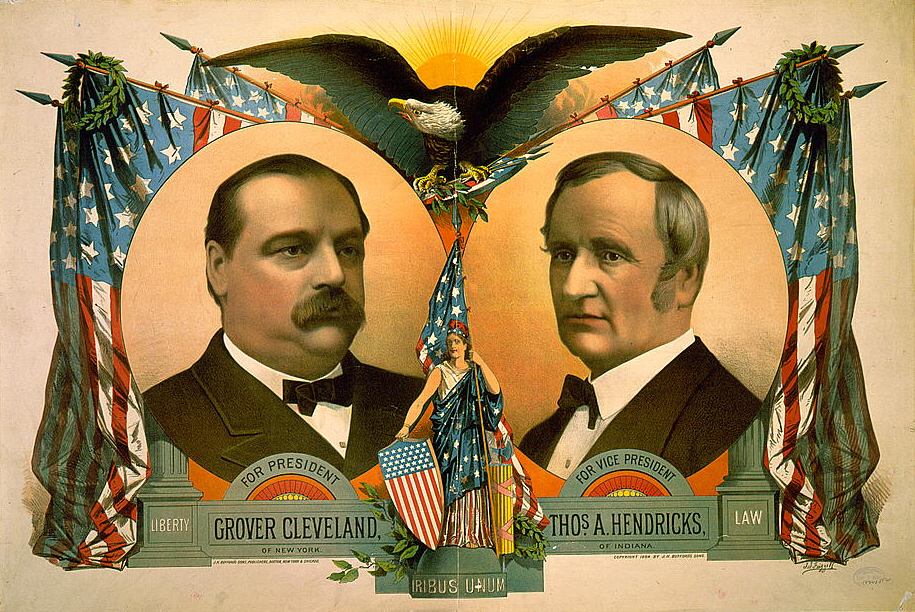
Cleveland vs. Blaine
The 1884 election was also a contentious election. Moral character was key issue, and plenty of mudslinging all around. There were villains and insults all over the media. How does one know who to trust?
James Blaine of Maine had a long political career including Speaker of the House and Grover Cleveland’s Secretary of State among other offices before he secured the Republican nomination. However, letters surfaced proving that he received payments for his help in securing federal grants and other political favors.
Relative newcomer to the political scene, Democrat New York Governor Grover Cleveland had quickly risen to power with a reputation for honesty, self-reliance, and integrity. He had already won battles against political corruption and needless spending in New York, and he campaigned for political reform.
Then the news broke that he fathered an illegitimate son, forced the boy to be given up for adoption while sending the mother to an insane asylum. She was released 3 days later because the doctors did not find a reason to keep her.
A key faction in the race were the Mugwumps. Viewing Blaine as corrupt, the group defected from the Republican Party and threw their support to Cleveland. While trying to win back the Mugwumps, Blaine accidentally alienated the Irish and the Catholic voting blocs despite that fact that his sisters and mother’s family were Catholic.

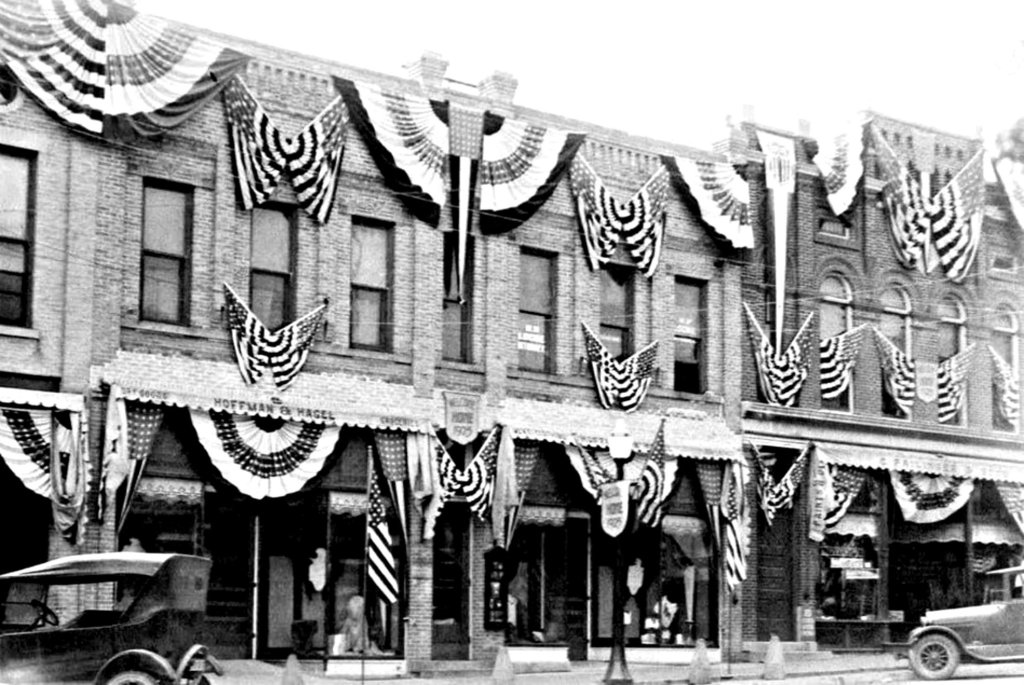
Waterloo’s Streets
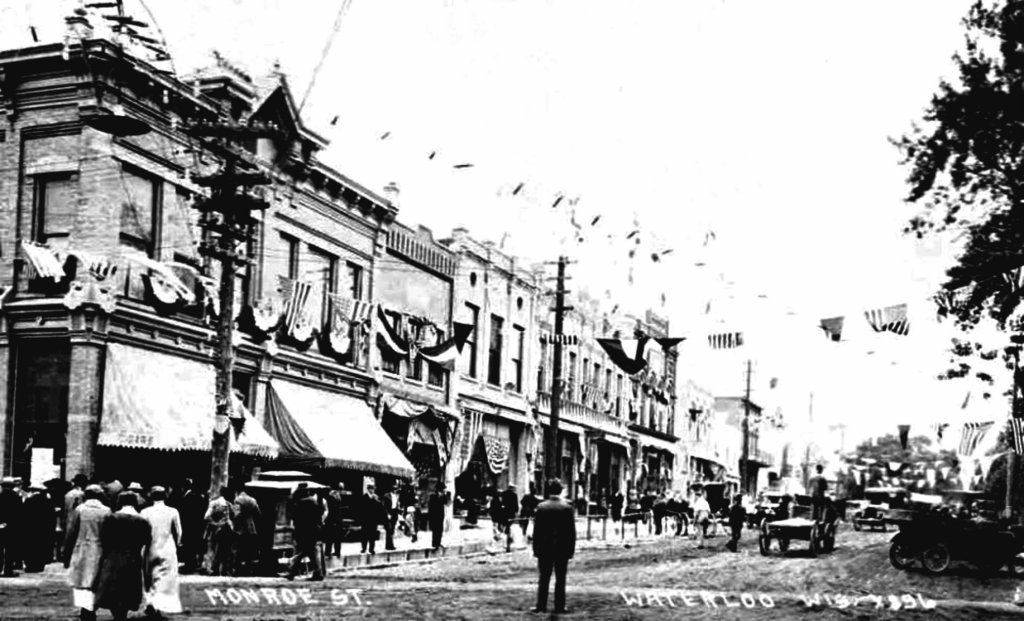
Waterloo has a history of being a civically minded town with a thing for US Presidents. All the streets in the 1875 town map are named after US Presidents. They have names like Washington, Adams, Jackson, Van Buren, Harrison, Polk, and Pierce. The main streets in town are named after the first two Jim’s: James Madison and James Monroe. The town is even located in a county named after Thomas Jefferson.
When one is surrounded by such names, is it even possible to ignore a presidential election? Can’t you just imagine the conversations in town? The stories, the histories, the tall tales, the trash talking, the fights… Could anyone even have a civil discussion anymore?
The Bet
In the midst of all those “discussions,” A.J. Roach and A.G. Hutchinson bet on the outcome of the election. The loser would push a wheelbarrow to the Wisconsin State Capitol Building 25 miles away. The winner would walk with him to oil the wheels when needed. Roach would push the wheelbarrow if Cleveland won the election. Hutchinson would push if Blaine won.
Was this a typical bet at the time? I don’t know. I found a couple examples of similar bets in the 1888 election. One was even featured in the Disney movie “The One and Only Genuine Original Family Band.” However, I haven’t yet found any earlier examples—if you know of some, please share in the comments!
The 1884 election
Men went to the polls on Tuesday, November 4, 1884. It was a close race. Cleveland won the popular vote 48.85% to Blaine’s 48.28%. Cleveland carried 20 out of the 38 states and thus received 219 of the electoral votes (compared to Blaine’s 182.)
Wisconsin was not one of Cleveland’s 20 states, although Jefferson county did favor Cleveland.
In the end, A.J. Roach would be pushing the wheelbarrow. His dad, James Roach, built a special wheelbarrow for the big event. It was a standard construction with one wheel and two legs. He built it to be light. Decorated in red, white, and blue and with American flags, it also featured portraits of Blaine and Logan.

Setting Out
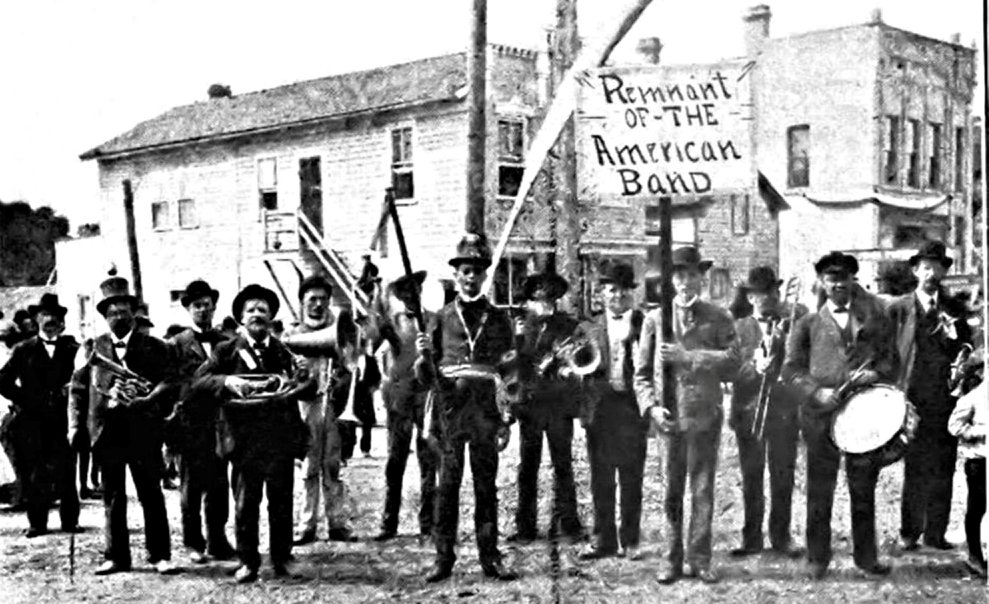
Word had spread about the bet, and the whole town got involved. The town even hired the Old American Silver Cornet Band to accompany the procession. This band is the one pictured in the first photo. They are shown near the intersection of Madison and Monroe streets—the main intersection of town.
The group started from the main intersection at 10am on Friday, December 5, 1884, with a grand flourish of trumpets. Typical for Southern Wisconsin in early December, the temperatures were in the upper 30s to low 40s (Fahrenheit). After the band, about 25 people followed the procession in various buggies and wagons. People along the route cheered or jeered as the parade passed.
The State Journal reports, “Roach made life a burden to Hutchinson as often as he could conveniently do so, but running the wheelbarrow up some muddy embankment and then demanding that the oil be applied. This necessitated a disagreeable climb for Hutchinson, but that gentleman proved himself equal to the occasion, and responded every time, as gracefully as the awkward position of the wheelbarrow would permit.”
The entourage arrived at the halfway point in Sun Prairie at 2pm where they were treated to a banquet by a local citizen. The group spent the night in the local hotel, at people’s homes, or in the park.
Day 2
Roach and Hutcheson slept well and woke early for the big day ahead. They left Sun Prairie at 8am—Roach still pushing the wheelbarrow of course. Faithful Hutchinson carrying the oil.
Unfortunately, the weather was not cooperative. The two set out in the rain, and with considerably fewer fans. Rain at 40F is fairly miserable, but they marched on.
The band and the rest of the spectators abandoned their open buggies and waited for the train. They caught the 10:50am passenger train from Milwaukee and arrived at the Madison East Side Train Depot at noon.
Hutchinson and Roach walked in shortly thereafter. They were greeted by three bands and a cheer from hundreds of spectators. The procession reformed, led by the Waterloo band, and Roach was heartily cheered along the route to the state capital building rotunda.
They were welcomed by Governor Rusk (Republican) and presented the wheelbarrow to the Wisconsin Historical Society. The governor praised Roach’s example of an agreement carried out in the face of hardships, thanked him for his faithfulness to his agreement, and noted that the greatest importance to the stability of the institutions of this country is that men keep their promises.
Roach described the manner in which the bet had been made, and presumably remembering the rancor of the election, concluded his speech with the words, “we now shake hands over the bloody chasm.”
The Aftermath
Without the extra weight of the wheelbarrow, the return trip was much quicker. The State Journal reported that the delegation departed for Sun Prairie on the 3:30pm passenger train. I assume that Roach and Hutchinson were able to hitch a ride back to Waterloo from Sun Prairie.
Did Waterloo get back to normal? Eventually. As normal as it ever was.
The town grew. More streets were added—streets named for trees, for early residents, and for the whims of developers. There weren’t any more streets named after US Presidents, except perhaps one. Technically, it is only one block, but it might be the worst one to pick if one were to have to push someone in a wheelbarrow down the block—say if one were to lose a bet or something—because it is a long block. On the map, at approximately 1000 feet, it looks like it would be worth about 2.5 of a typical Waterloo block. It is nearby but in a slightly different area and thus doesn’t quite fit the pattern of the other presidential streets. Cleveland Street. Was it named after Grover Cleveland?
I don’t know; I didn’t research it because it is fun to think that after the wheelbarrow bet, the town named the street so they would never forget. Never forget about the time this town lived through an angry, contentious, cantankerous election and still afterwards found a way to cheer on a remarkable journey together as friends.

What is the craziest bet that you’ve been part of?
How far would you go for your candidate?
How far would you go for your friend or community?
References:
Report and Collections of the State Historical Society of Wisconsin, Volume 10, For the Years 1883, 1884, and 1885. Pg 37. Democrat Printing Company, State Printers. Madison, Wisconsin 1888.
The Wisconsin State Journal (Madison, Wisconsin) 06 December 1884
The Saint Paul Globe (Saint Paul, Minnesota) 07 December 1884
https://en.wikipedia.org/wiki/1884_United_States_presidential_election
 Learning Adventure